 |
|
Please Whitelist This Site?
I know everyone hates ads. But please understand that I am providing premium content for free that takes hundreds of hours of time to research and write. I don't want to go to a pay-only model like some sites, but when more and more people block ads, I end up working for free. And I have a family to support, just like you. :)
If you like The TCP/IP Guide, please consider the download version. It's priced very economically and you can read all of it in a convenient format without ads.
If you want to use this site for free, I'd be grateful if you could add the site to the whitelist for Adblock. To do so, just open the Adblock menu and select "Disable on tcpipguide.com". Or go to the Tools menu and select "Adblock Plus Preferences...". Then click "Add Filter..." at the bottom, and add this string: "@@||tcpipguide.com^$document". Then just click OK.
Thanks for your understanding!
Sincerely, Charles Kozierok
Author and Publisher, The TCP/IP Guide

|
|
|

Custom Search
|

|


DHCP Autoconfiguration / Automatic Private IP Addressing (APIPA)
(Page 2 of 3)
APIPA Operation
APIPA is really so simple that it's surprising it took so long for someone to come up with the idea. It takes over at the point where any DHCP lease process fails. Instead of just halting with an error message, APIPA randomly chooses an address within the aforementioned private addressing block. It then performs a test very similar to the one in step #13 in the DHCP allocation process: it uses ARP to generate a request on the local network to see if any other client responds using the address it has chosen. If there is a reply, APIPA tries another random address and repeats the test. When the APIPA software finds an address that is not in use, it is given to the client as a default address. The client will then use default values for other configuration parameters that it would normally receive from the DHCP server. This process is illustrated in Figure 269.
|
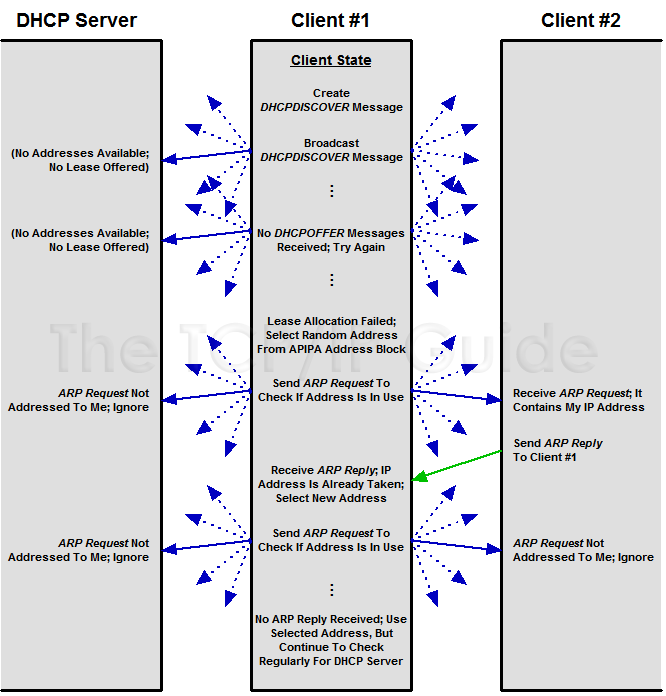
A client using an autoconfigured address will continue to try to contact a DHCP server periodically. By default, this check is performed every five minutes. If and when it finds one, it will obtain a lease and replace the autoconfigured address with the proper leased address.
APIPA is ideally suited to small networks, where all devices are on a single physical link. Conceivably, with 20 APIPA-enabled DHCP clients on a network with a single DHCP server, you could take the server down for maintenance and still have all the clients work properly, using 169.254.x.x addresses.
|
| |||||||||||||||||||
Home - Table Of Contents - Contact Us
The TCP/IP Guide (http://www.TCPIPGuide.com)
Version 3.0 - Version Date: September 20, 2005
© Copyright 2001-2005 Charles M. Kozierok. All Rights Reserved.
Not responsible for any loss resulting from the use of this site.