 |
|
Please Whitelist This Site?
I know everyone hates ads. But please understand that I am providing premium content for free that takes hundreds of hours of time to research and write. I don't want to go to a pay-only model like some sites, but when more and more people block ads, I end up working for free. And I have a family to support, just like you. :)
If you like The TCP/IP Guide, please consider the download version. It's priced very economically and you can read all of it in a convenient format without ads.
If you want to use this site for free, I'd be grateful if you could add the site to the whitelist for Adblock. To do so, just open the Adblock menu and select "Disable on tcpipguide.com". Or go to the Tools menu and select "Adblock Plus Preferences...". Then click "Add Filter..." at the bottom, and add this string: "@@||tcpipguide.com^$document". Then just click OK.
Thanks for your understanding!
Sincerely, Charles Kozierok
Author and Publisher, The TCP/IP Guide

|
|

|

Custom Search
|

|


DNS Message Processing and General Message Format
(Page 1 of 3)
The previous topic discussed DNS message exchanges and the fact that they are all based on the principle of client/server computing. In a particular exchange, one device acts as a client, initiating the communication by sending a query; the other acts as the server by responding to the query with an answer. This “query/response” behavior is an integral part of DNS, and is reflected in the format used for DNS messages.
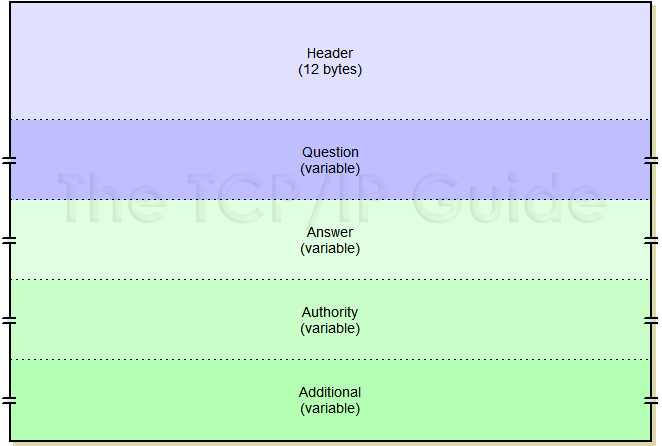
A common message format is used for DNS queries and responses. This message format contains five sections that provide a place for the query asked by the client; the answer(s) provided by the server; and header information that controls the entire process. Table 168 describes the DNS general message format, providing a brief summary of each of its sections and how they are used. You can also see a simplified illustration of the message format in Figure 247.
Section Name |
Description |
Header |
Contains fields that describe the type of message and provide important information about it. Also contains fields that indicate the number of entries in the other sections of the message. |
Question |
Carries one or more “questions”, that is, queries for information being sent to a DNS name server. |
Answer |
Carries one or more resource records that answer the question(s) indicated in the Question section above. |
Authority |
Contains one or more resource records that point to authoritative name servers that can be used to continue the resolution process. |
Additional |
Conveys one or more resource records that contain additional information related to the query that is not strictly necessary to answer the queries (questions) in the message. |
|
|
| |||||||||||||||||||
Home - Table Of Contents - Contact Us
The TCP/IP Guide (http://www.TCPIPGuide.com)
Version 3.0 - Version Date: September 20, 2005
© Copyright 2001-2005 Charles M. Kozierok. All Rights Reserved.
Not responsible for any loss resulting from the use of this site.