 |
|
Please Whitelist This Site?
I know everyone hates ads. But please understand that I am providing premium content for free that takes hundreds of hours of time to research and write. I don't want to go to a pay-only model like some sites, but when more and more people block ads, I end up working for free. And I have a family to support, just like you. :)
If you like The TCP/IP Guide, please consider the download version. It's priced very economically and you can read all of it in a convenient format without ads.
If you want to use this site for free, I'd be grateful if you could add the site to the whitelist for Adblock. To do so, just open the Adblock menu and select "Disable on tcpipguide.com". Or go to the Tools menu and select "Adblock Plus Preferences...". Then click "Add Filter..." at the bottom, and add this string: "@@||tcpipguide.com^$document". Then just click OK.
Thanks for your understanding!
Sincerely, Charles Kozierok
Author and Publisher, The TCP/IP Guide

|
|

|

Custom Search
|

|


DNS Message Resource Record Field Formats
(Page 4 of 5)
SOA / Start Of Authority Resource Record (Type Value 6)
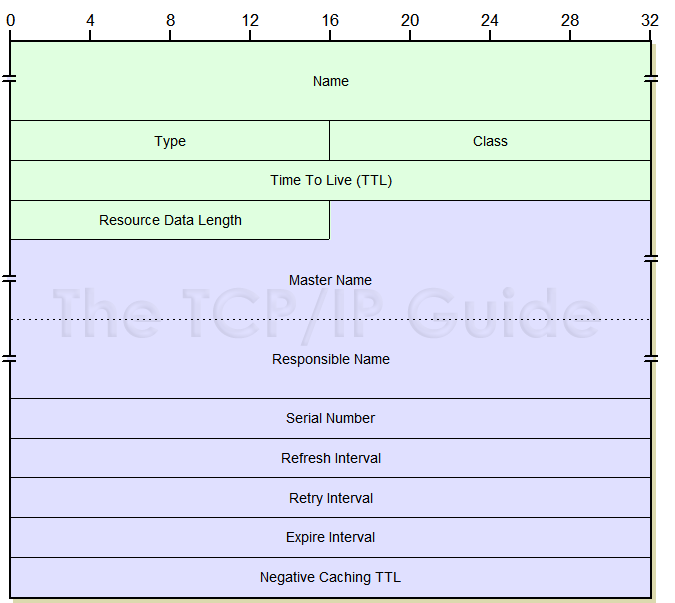
This record marks the start of DNS zone and contains key information about how it is to be managed and used. The SOA record is the most complex of the DNS resource record types; its format can be found in Table 175 and also in Figure 251.
Subfield Name |
Size (bytes) |
Description |
MName |
Variable |
Master Name: The domain name of the name server that is the source of the data for the zone; this is of course normally the primary authoritative server for the zone. It is encoded using the standard DNS name format. |
RName |
Variable |
Responsible Name: The electronic mail address of the person responsible for this zone. E-mail addresses in DNS are encoded using a special variation of the regular DNS name notation. |
Serial |
4 |
Serial Number: The serial number, or version number, of the resource record database for this zone. Used to determine when changes have been made to the database to trigger zone transfers. See the topic on zone transfers for information on how this field is used. |
Refresh |
4 |
Refresh Interval: The number of seconds that secondary name servers for this zone will wait between attempts to check for changes made to the zone database on the primary name server. See the topic on zone transfers for information on how this field is used. |
Retry |
4 |
Retry Interval: The number of seconds a secondary name server waits before trying again to check with a primary for changes if its previous attempt failed. See the topic on zone transfers for details. |
Expire |
4 |
Expire Interval: The number of seconds that can elapse between successful contacts with the primary name server before a secondary name server must consider the information it holds “stale”. |
Minimum |
4 |
Negative Caching TTL: Originally carried the default Time To Live value for records where no explicit TTL value was specified. Now represents the zone’s negative cache TTL. See the topic on DNS name server caching. |
|
|
| |||||||||||||||||||
Home - Table Of Contents - Contact Us
The TCP/IP Guide (http://www.TCPIPGuide.com)
Version 3.0 - Version Date: September 20, 2005
© Copyright 2001-2005 Charles M. Kozierok. All Rights Reserved.
Not responsible for any loss resulting from the use of this site.