 |
|
Please Whitelist This Site?
I know everyone hates ads. But please understand that I am providing premium content for free that takes hundreds of hours of time to research and write. I don't want to go to a pay-only model like some sites, but when more and more people block ads, I end up working for free. And I have a family to support, just like you. :)
If you like The TCP/IP Guide, please consider the download version. It's priced very economically and you can read all of it in a convenient format without ads.
If you want to use this site for free, I'd be grateful if you could add the site to the whitelist for Adblock. To do so, just open the Adblock menu and select "Disable on tcpipguide.com". Or go to the Tools menu and select "Adblock Plus Preferences...". Then click "Add Filter..." at the bottom, and add this string: "@@||tcpipguide.com^$document". Then just click OK.
Thanks for your understanding!
Sincerely, Charles Kozierok
Author and Publisher, The TCP/IP Guide

|
|
|

Custom Search
|

|


DNS Structural Elements and Terminology: Domains, Subdomains, and Nodes; Roots, Leaves and Branches; Parents, Children and Siblings
(Page 3 of 3)
DNS Family-Related Terminology
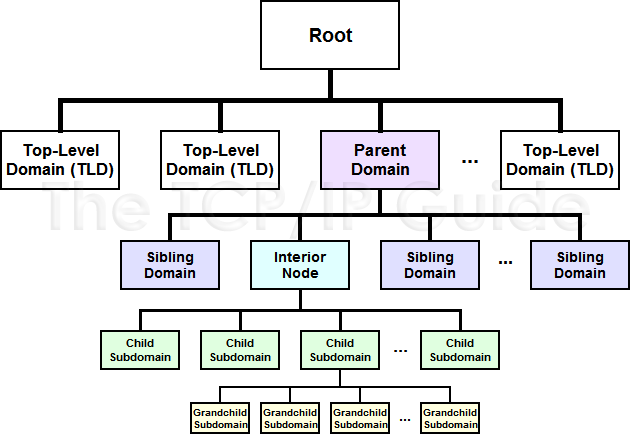
Another set of terminology you will run into compares the DNS tree structure not to a living tree, but in fact, to another analogy: a family tree. These terms are most often used to describe how a particular domain under discussion relates to the other domains or subdomains around it, so they are relative terms. The ones usually seen are (see Figure 237):
- Parent Domain: The domain that is above
this one in the hierarchy. For example, the root domain is the parent
of all top-level domains.
- Child: A domain at the next level down
from this one in the hierarchy. Thus, the top-level domains are children
of the root.
- Sibling: A peer at the same level as this
one in the hierarchy, with the same parent. Thus, all top-level domains
are siblings with the root as a parent; all second-level domains within
a particular TLD are siblings and so on.
Figure 237: DNS Name Space “Family Tree”
This diagram is similar to Figure 236, but I have labeled the nodes differently to show the “family-oriented” terminology sometimes used in DNS. In this case, the names are relative to the interior node shown in cyan. The domain immediately above it is its parent node; other nodes on the same level are siblings, and subdomains within it are children of that node.
|
 Key Concept: The domain above a given domain in the DNS name space is called its parent domain; domains at the same level within the same parent are siblings; and subdomains are called children of that domain.
Note that like a real tree, the DNS name structure must be a true tree in its structure. Every domain can have only one parent (except the root), just as every branch of a tree connects to only one limb (except the root/trunk). Also, no “loops” can appear in the structure; you can't have a domain whose child is also its parent, for example.
|
I also want to point out that even though the name hierarchy represents an arrangement of named devices, it is only a logical structure. There is no necessary correspondence to the physical location of devices. A domain with ten children may represent 11 devices in 11 different countries. We'll explore this more when we look at DNS authority structures.
|
| |||||||||||||||||||
Home - Table Of Contents - Contact Us
The TCP/IP Guide (http://www.TCPIPGuide.com)
Version 3.0 - Version Date: September 20, 2005
© Copyright 2001-2005 Charles M. Kozierok. All Rights Reserved.
Not responsible for any loss resulting from the use of this site.