 |
|
Please Whitelist This Site?
I know everyone hates ads. But please understand that I am providing premium content for free that takes hundreds of hours of time to research and write. I don't want to go to a pay-only model like some sites, but when more and more people block ads, I end up working for free. And I have a family to support, just like you. :)
If you like The TCP/IP Guide, please consider the download version. It's priced very economically and you can read all of it in a convenient format without ads.
If you want to use this site for free, I'd be grateful if you could add the site to the whitelist for Adblock. To do so, just open the Adblock menu and select "Disable on tcpipguide.com". Or go to the Tools menu and select "Adblock Plus Preferences...". Then click "Add Filter..." at the bottom, and add this string: "@@||tcpipguide.com^$document". Then just click OK.
Thanks for your understanding!
Sincerely, Charles Kozierok
Author and Publisher, The TCP/IP Guide

|
|

|

Custom Search
|

|


HTTP Operational Model and Client/Server Communication
(Page 2 of 3)
Intermediaries and The HTTP Request/Response Chain
The simple request/response pair between a client and server becomes more complex when intermediaries are placed in the virtual communication path between the client and server. These are devices such as proxies, gateways or tunnels that are used to improve performance, provide security or perform other necessary functions for particular clients or servers. Proxies are particularly commonly used on the Web, because they can greatly improve response time for groups of related client computers.
When an intermediary is involved in HTTP communication, it acts as a “middleman”. Rather than the client speaking directly to the server and vice-versa, they each talk to the intermediary. This allows the intermediary to perform functions such as caching, translation, aggregation, or encapsulation. For example, consider an exchange through a single intermediary device. The two-step communication process above would become four steps:
- Client Request: The HTTP client
sends a request message to the intermediary device.
- Intermediary Request: The intermediary
processes the request, making changes to it if necessary. It then forwards
the request to the actual server.
- Server Response: The server
reads and interprets the request, takes appropriate action and then
sends a response. Since it received its request from the intermediary,
its reply goes back to the intermediary.
- Intermediary Response: The intermediary processes the request, again possibly making changes, and then forwards it back to the client.
As you can see, the intermediary acts as if it were a server from the client's perspective, and as a client from the server's viewpoint. Many intermediaries are designed to be able to “intercept” a variety of TCP/IP protocols, by “posing” as the server to a client and the client to a server. Most protocols are unaware of the existence of the interposition of an intermediary in this fashion. HTTP, however, includes special support for certain intermediaries such as proxy servers, providing headers that control how intermediaries handle HTTP requests and replies.
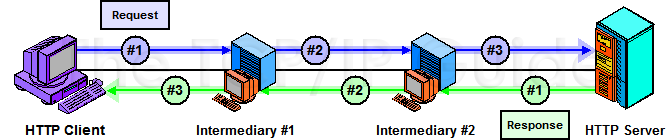
It is possible for two or more intermediaries to be linked together between the client and server. For example, the client might send a request to intermediary 1, which then forwards to intermediary 2, which then talks to the server; see Figure 316. The process is reversed for the reply. The HTTP standard uses the phrase request/response chain to refer collectively to the entire set of devices involved in an HTTP message exchange.
|
|
 Key Concept: The simple client/server operational model of HTTP is complicated when intermediary devices such as proxies, tunnels or gateways are inserted in the communication path between the HTTP client and server. HTTP/1.1 is specifically designed with features to support the efficient conveyance of requests and responses through a series of steps from the client through the intermediaries to the server, and back again. The entire set of devices involved in such a communication is called the request/response chain.
|
| |||||||||||||||||||
Home - Table Of Contents - Contact Us
The TCP/IP Guide (http://www.TCPIPGuide.com)
Version 3.0 - Version Date: September 20, 2005
© Copyright 2001-2005 Charles M. Kozierok. All Rights Reserved.
Not responsible for any loss resulting from the use of this site.