 |
|
Please Whitelist This Site?
I know everyone hates ads. But please understand that I am providing premium content for free that takes hundreds of hours of time to research and write. I don't want to go to a pay-only model like some sites, but when more and more people block ads, I end up working for free. And I have a family to support, just like you. :)
If you like The TCP/IP Guide, please consider the download version. It's priced very economically and you can read all of it in a convenient format without ads.
If you want to use this site for free, I'd be grateful if you could add the site to the whitelist for Adblock. To do so, just open the Adblock menu and select "Disable on tcpipguide.com". Or go to the Tools menu and select "Adblock Plus Preferences...". Then click "Add Filter..." at the bottom, and add this string: "@@||tcpipguide.com^$document". Then just click OK.
Thanks for your understanding!
Sincerely, Charles Kozierok
Author and Publisher, The TCP/IP Guide

|
|
|

Custom Search
|

|


NNTP Inter-Server Communication Process: News Article Propagation
(Page 3 of 4)
Article Propagation Using the "Push" Model
Here’s how the push model works. When the administrators of an NNTP server establish a service relationship with an upstream Usenet service provider, they furnish the provider with a list of newsgroups that the downstream server wants to carry. Whenever a new article arrives at the upstream server within that list of groups, it is automatically sent to the downstream site. This saves the downstream server from constantly having to ask “has anything arrived?”
In the classical NNTP protocol as defined in RFC 977, the exchange of articles is based on the push model, and performed using the IHAVE command. Suppose three new messages arrive at the largenews server. It would establish an NNTP connection to mediumnews and use IHAVE to provide the message IDs of each of the three new messages, one at a time. The mediumnews server would respond to each one indicating whether it already had that message or not. If not, largenews would send it the message. An example article transaction using the push model of propagation is illustrated in Figure 312.
|
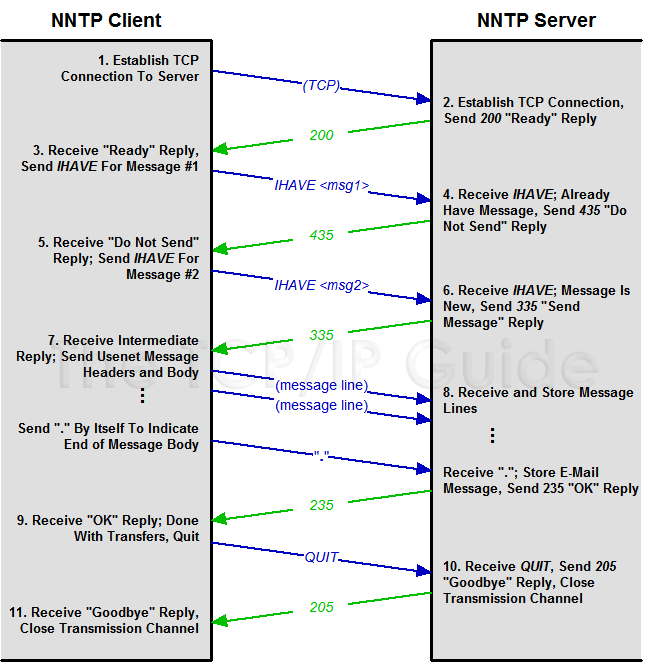
The main advantage of this technique is that it ensures that a server is not sent a duplicate copy of a message that it already has. The problem with it in modern Usenet is that it is slow, because the server must respond to the IHAVE command before the message or the next command can be sent by the client.
|
| |||||||||||||||||||
Home - Table Of Contents - Contact Us
The TCP/IP Guide (http://www.TCPIPGuide.com)
Version 3.0 - Version Date: September 20, 2005
© Copyright 2001-2005 Charles M. Kozierok. All Rights Reserved.
Not responsible for any loss resulting from the use of this site.