 |
|
Please Whitelist This Site?
I know everyone hates ads. But please understand that I am providing premium content for free that takes hundreds of hours of time to research and write. I don't want to go to a pay-only model like some sites, but when more and more people block ads, I end up working for free. And I have a family to support, just like you. :)
If you like The TCP/IP Guide, please consider the download version. It's priced very economically and you can read all of it in a convenient format without ads.
If you want to use this site for free, I'd be grateful if you could add the site to the whitelist for Adblock. To do so, just open the Adblock menu and select "Disable on tcpipguide.com". Or go to the Tools menu and select "Adblock Plus Preferences...". Then click "Add Filter..." at the bottom, and add this string: "@@||tcpipguide.com^$document". Then just click OK.
Thanks for your understanding!
Sincerely, Charles Kozierok
Author and Publisher, The TCP/IP Guide

|
|
|

Custom Search
|

|


TFTP Detailed Operation and Messaging
(Page 2 of 3)
TFTP Read Process Steps
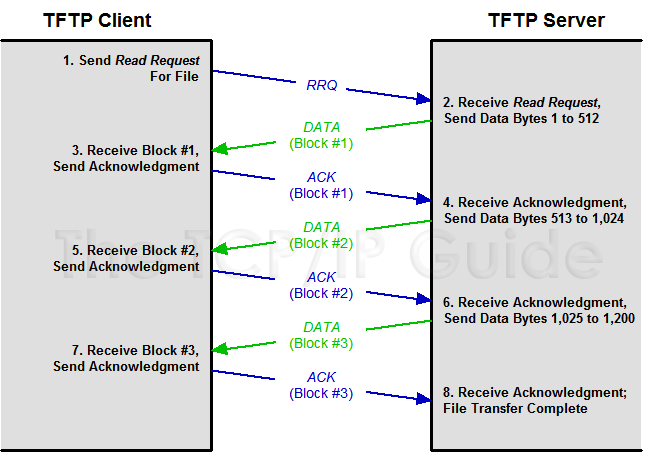
Let's use an example to see how TFTP messaging works. Suppose the client wants to read a particular file that is 1,200 bytes long. Here are the steps in simplified form (also displayed in Figure 293):
- The client sends a read request to
the server, specifying the name of the file.
- The server sends back a data message
containing block #1, carrying 512 bytes of data.
- The client receives the data, and sends
back an acknowledgment for block #1.
- The server sends block #2, with 512
bytes of data.
- The client receives block #2, and sends
back an acknowledgment for it.
- The server sends block #3, containing
176 bytes of data. It waits for an acknowledgment before terminating
the logical connection.
- The client receives the data, sends
an acknowledgment for block #3. Since this data message had fewer than
512 bytes, it knows the file is complete.
- The server receives the acknowledgment,
and knows the file was received successfully.
Figure 293: TFTP Read Process
In this example, the client starts the process of reading a file by sending a request for it to the server. The server acknowledges this request by immediately sending a DATA message carrying block #1, containing the first 512 bytes of the file. The client acknowledges this with an ACK message for block #1. The server then sends block #2, containing bytes 513 to 1,024, which the client acknowledges. When the client receives block #3, it realizes it has only 176 bytes, which marks it as the last block of the file.
|
| |||||||||||||||||||
Home - Table Of Contents - Contact Us
The TCP/IP Guide (http://www.TCPIPGuide.com)
Version 3.0 - Version Date: September 20, 2005
© Copyright 2001-2005 Charles M. Kozierok. All Rights Reserved.
Not responsible for any loss resulting from the use of this site.