 |
|
Please Whitelist This Site?
I know everyone hates ads. But please understand that I am providing premium content for free that takes hundreds of hours of time to research and write. I don't want to go to a pay-only model like some sites, but when more and more people block ads, I end up working for free. And I have a family to support, just like you. :)
If you like The TCP/IP Guide, please consider the download version. It's priced very economically and you can read all of it in a convenient format without ads.
If you want to use this site for free, I'd be grateful if you could add the site to the whitelist for Adblock. To do so, just open the Adblock menu and select "Disable on tcpipguide.com". Or go to the Tools menu and select "Adblock Plus Preferences...". Then click "Add Filter..." at the bottom, and add this string: "@@||tcpipguide.com^$document". Then just click OK.
Thanks for your understanding!
Sincerely, Charles Kozierok
Author and Publisher, The TCP/IP Guide

|
|
|

Custom Search
|

|


Address Resolution Through Direct Mapping
(Page 2 of 3)
Direct Mapping Not Possible With Large Hardware Addresses
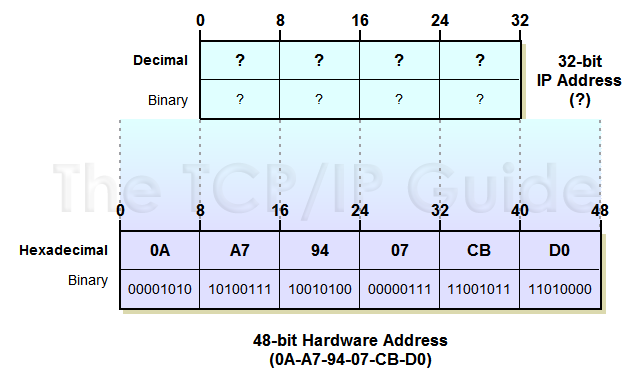
Unfortunately, direct mapping only works when it is possible to express the data link layer address as a function of the network layer address. Consider instead the same IP address, 222.101.33.29, running on an Ethernet network. Here, the data link layer addresses are “hard-wired” into the hardware itself (they can sometimes be overridden but usually this is not done). More importantly, the MAC address is 48 bits wide, not 8. This means the layer two address is bigger than the layer three address, and there is no way to do direct mapping, as Figure 46 illustrates.
|
|
 Note: In the case where the hardware address size exceeds the network layer address size, we could do a “partial mapping”. For example, we could use the IP address to get part of the MAC address and hope we don't have duplication in the bits we didn't use. This method is not well-suited to regular transmissions, but is in fact used for
 In general, then, direct mapping is not possible when the layer three address is smaller than the layer two address. Consider that Ethernet is the most popular technology at layer two and uses a 48-bit address, and IP is the most popular technology at layer three and uses a 32-bit address. This is one reason why direct mapping is a technique that is not only not widely used, but that most people don't know about!
|
| |||||||||||||||||||
Home - Table Of Contents - Contact Us
The TCP/IP Guide (http://www.TCPIPGuide.com)
Version 3.0 - Version Date: September 20, 2005
© Copyright 2001-2005 Charles M. Kozierok. All Rights Reserved.
Not responsible for any loss resulting from the use of this site.