 |
|
Please Whitelist This Site?
I know everyone hates ads. But please understand that I am providing premium content for free that takes hundreds of hours of time to research and write. I don't want to go to a pay-only model like some sites, but when more and more people block ads, I end up working for free. And I have a family to support, just like you. :)
If you like The TCP/IP Guide, please consider the download version. It's priced very economically and you can read all of it in a convenient format without ads.
If you want to use this site for free, I'd be grateful if you could add the site to the whitelist for Adblock. To do so, just open the Adblock menu and select "Disable on tcpipguide.com". Or go to the Tools menu and select "Adblock Plus Preferences...". Then click "Add Filter..." at the bottom, and add this string: "@@||tcpipguide.com^$document". Then just click OK.
Thanks for your understanding!
Sincerely, Charles Kozierok
Author and Publisher, The TCP/IP Guide

|
|

|

Custom Search
|

|


BGP Message Generation and Transport, and General Message Format
(Page 2 of 3)
BGP General Message Format
The use of TCP also has an interesting impact on the way BGP messages are structured. One thing that stands out when you look at the BGP message format (as we will see shortly) is that a BGP message can have an odd number of bytes. Most routing protocols are sized in units of 4 or 8 bytes, but since TCP sends data as a stream of octets there is no need for BGP messages to break on a 32-bit or 64-bit boundary. The other impact is the need of a special Marker field to help ensure that BGP messages can be differentiated from each other in the TCP stream (more about this in a moment).
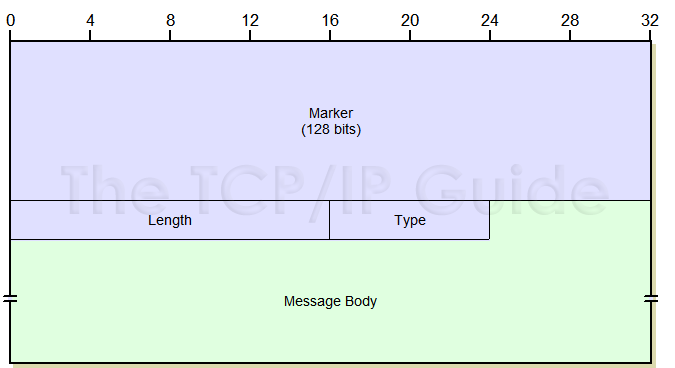
Like most messaging protocols, BGP uses a common message format for each of its four message types. Each BGP message is conceptually divided into a header and a body (called the data portion in the BGP standard). The header has three fields and is fixed in length at 19 bytes. The body is variable in length, and in fact is omitted entirely in Keepalive messages, since it is not needed for them.
The general format for all BGP message types is shown in Table 136 and Figure 192.
Field Name |
Size (bytes) |
Description |
Marker |
16 |
Marker: This large field at the start of each BGP message is used for synchronization and authentication. |
Length |
2 |
Length: The total length of the message in bytes, including the fields of the header. The minimum value of this field is 19 for a Keepalive message; it may be as high as 4,096. |
Type |
1 |
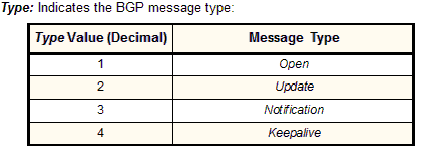
|
Message Body / Data Portion |
Variable |
Message Body / Data Portion: Contains the specific fields used to implement each message type, for Open, Update and Notification messages. |
|
|
| |||||||||||||||||||
Home - Table Of Contents - Contact Us
The TCP/IP Guide (http://www.TCPIPGuide.com)
Version 3.0 - Version Date: September 20, 2005
© Copyright 2001-2005 Charles M. Kozierok. All Rights Reserved.
Not responsible for any loss resulting from the use of this site.