 |
|
Please Whitelist This Site?
I know everyone hates ads. But please understand that I am providing premium content for free that takes hundreds of hours of time to research and write. I don't want to go to a pay-only model like some sites, but when more and more people block ads, I end up working for free. And I have a family to support, just like you. :)
If you like The TCP/IP Guide, please consider the download version. It's priced very economically and you can read all of it in a convenient format without ads.
If you want to use this site for free, I'd be grateful if you could add the site to the whitelist for Adblock. To do so, just open the Adblock menu and select "Disable on tcpipguide.com". Or go to the Tools menu and select "Adblock Plus Preferences...". Then click "Add Filter..." at the bottom, and add this string: "@@||tcpipguide.com^$document". Then just click OK.
Thanks for your understanding!
Sincerely, Charles Kozierok
Author and Publisher, The TCP/IP Guide

|
|
|

Custom Search
|

|


ICMPv4 Address Mask Request and Reply Messages
(Page 2 of 2)
ICMPv4 Address Mask Request and Address Mask Reply Message Format
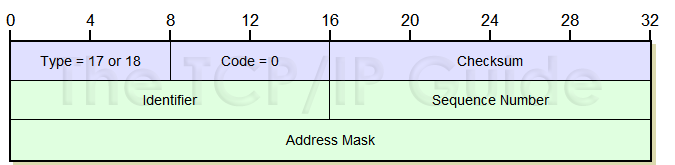
The Address Mask Request and Address Mask Reply, like some other request/reply pairs, have the same basic format—the host creates the request with all fields filled in except the subnet mask value itself, and the router supplies the mask and sends the reply back to the host. The format is described in Table 100 and Figure 150.
Field Name |
Size (bytes) |
Description |
Type |
1 |
Type: Identifies the ICMP message type. For Address Mask Request messages the value is 17; for Address Mask Reply messages, it is 18. |
Code |
1 |
Code: Not used for either message type; set to 0. |
Checksum |
2 |
Checksum: 16-bit checksum field for the ICMP header, as described in the topic on the ICMP common message format. |
Identifier |
2 |
Identifier: An identification field that can be used to help in matching Address Mask Request and Address Mask Reply messages. |
Sequence Number |
2 |
Sequence Number: A sequence number to help in matching Address Mask Request and Address Mask Reply messages. |
Address Mask |
4 |
Address Mask: The subnet mask for the local network, filled in by the router in the Address Mask Reply message. |
The Identifier and Sequence Number fields can be used to match up requests and replies, as they are for Echo and Echo Reply messages. However, a host won't normally send multiple requests for subnet masks the way it might send Echo messages for testing. For this reason, the Identifier and Sequence Number fields may be ignored by some implementations.
|
The use of Address Mask Request and Address Mask Reply messages is optional, just as the router discovery described in the previous topic is. Other methods besides these messages or manual configuration may be used to tell a host what subnet mask to use. Again, a common alternative to ICMP for this is a host configuration protocol like the TCP/IP Dynamic Host Configuration Protocol (DHCP). Routers do have to be able to respond to Address Mask Requests for hosts that choose to send them.
|
| |||||||||||||||||||
Home - Table Of Contents - Contact Us
The TCP/IP Guide (http://www.TCPIPGuide.com)
Version 3.0 - Version Date: September 20, 2005
© Copyright 2001-2005 Charles M. Kozierok. All Rights Reserved.
Not responsible for any loss resulting from the use of this site.