 |
|
Please Whitelist This Site?
I know everyone hates ads. But please understand that I am providing premium content for free that takes hundreds of hours of time to research and write. I don't want to go to a pay-only model like some sites, but when more and more people block ads, I end up working for free. And I have a family to support, just like you. :)
If you like The TCP/IP Guide, please consider the download version. It's priced very economically and you can read all of it in a convenient format without ads.
If you want to use this site for free, I'd be grateful if you could add the site to the whitelist for Adblock. To do so, just open the Adblock menu and select "Disable on tcpipguide.com". Or go to the Tools menu and select "Adblock Plus Preferences...". Then click "Add Filter..." at the bottom, and add this string: "@@||tcpipguide.com^$document". Then just click OK.
Thanks for your understanding!
Sincerely, Charles Kozierok
Author and Publisher, The TCP/IP Guide

|
|

|

Custom Search
|

|


ICMPv6 Neighbor Advertisement and Neighbor Solicitation Messages
(Page 2 of 4)
ICMPv6 Neighbor Advertisement Message Format
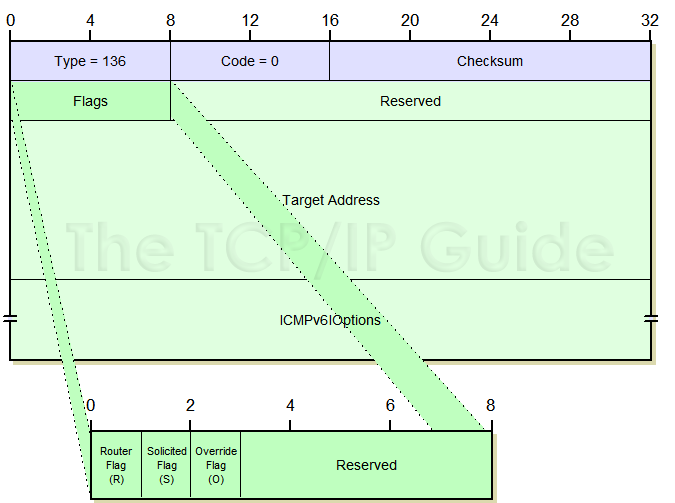
The format for the Neighbor Advertisement message is described in Table 111 and Figure 160.
Field Name |
Size (bytes) |
Description |
Type |
1 |
Type: Identifies the ICMPv6 message type; for Neighbor Advertisement messages the value is 136. |
Code |
1 |
Code: Not used; set to 0. |
Checksum |
2 |
Checksum: 16-bit checksum field for the ICMP header, as described in the topic on the ICMP common message format. |
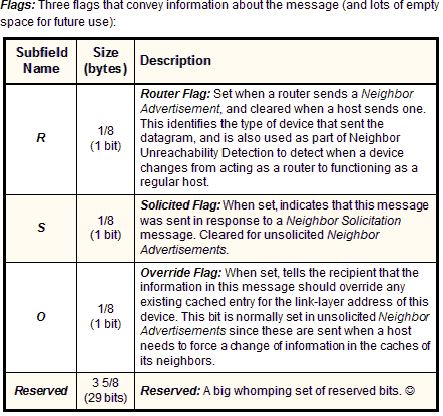
Flags |
4 |
|
Target Address |
16 |
Target Address:
If the Neighbor Advertisement is being sent in response to a
Neighbor Solicitation, this is the same value as in the Target
Address field of the Solicitation. This field will commonly
contain the IPv6 address of the device sending the Neighbor Advertisement,
but not in all cases. For example, if a device responds as a proxy for
the target of the Neighbor Solicitation, the Target Address
field contains the address of the target, not the device sending the
response. See the topic on
address resolution proxying for details. |
Options |
Variable |
Options:
When sent in response to a multicast Neighbor Solicitation, a
Neighbor Advertisement message must contain a Target Link-Layer
Address option, which carries the link-layer address of the device
sending the message. This is a good example of an “option”
that's not really “optional”. J |
|
|
| |||||||||||||||||||
Home - Table Of Contents - Contact Us
The TCP/IP Guide (http://www.TCPIPGuide.com)
Version 3.0 - Version Date: September 20, 2005
© Copyright 2001-2005 Charles M. Kozierok. All Rights Reserved.
Not responsible for any loss resulting from the use of this site.