 |
|
Please Whitelist This Site?
I know everyone hates ads. But please understand that I am providing premium content for free that takes hundreds of hours of time to research and write. I don't want to go to a pay-only model like some sites, but when more and more people block ads, I end up working for free. And I have a family to support, just like you. :)
If you like The TCP/IP Guide, please consider the download version. It's priced very economically and you can read all of it in a convenient format without ads.
If you want to use this site for free, I'd be grateful if you could add the site to the whitelist for Adblock. To do so, just open the Adblock menu and select "Disable on tcpipguide.com". Or go to the Tools menu and select "Adblock Plus Preferences...". Then click "Add Filter..." at the bottom, and add this string: "@@||tcpipguide.com^$document". Then just click OK.
Thanks for your understanding!
Sincerely, Charles Kozierok
Author and Publisher, The TCP/IP Guide

|
|
|

Custom Search
|

|


ICMPv6 Router Renumbering Messages
(Page 2 of 2)
ICMPv6 Router Renumbering Message Format
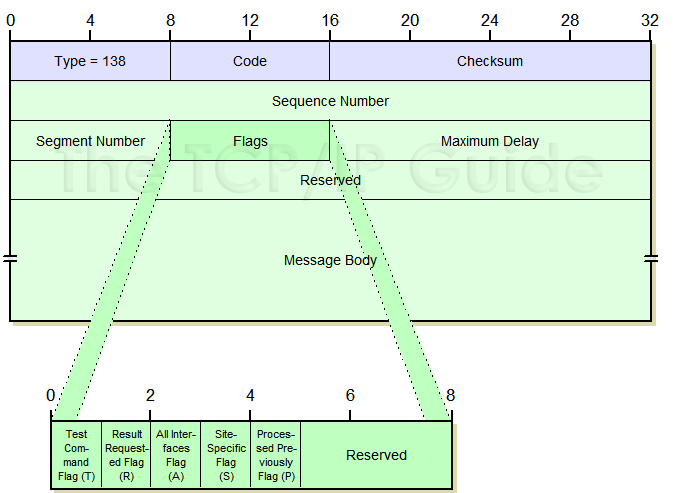
The format of Router Renumbering messages is in Table 114 and Figure 163.
Field Name |
Size (bytes) |
Description |
Type |
1 |
Type: Identifies the ICMPv6 message type; for Router Renumbering messages the value is 138. |
Code |
1 |
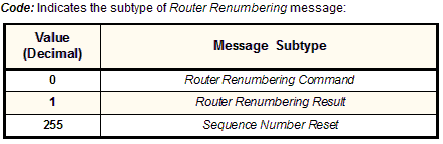
|
Checksum |
2 |
Checksum: 16-bit checksum field for the ICMP header, as described in the topic on the ICMP common message format. |
Sequence Number |
4 |
Sequence Number: A 32-bit sequence number used to guard against “replay” attacks by allowing a recipient to detect stale, duplicate or “out of order” commands. |
Segment Number |
1 |
Segment Number: Differentiates between valid Router Renumbering messages within the same Sequence Number. |
Flags |
1 |
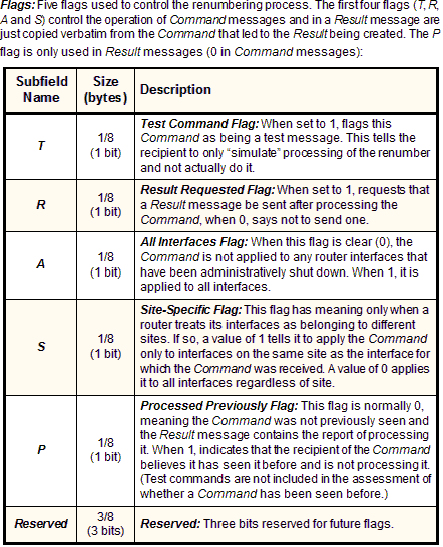
|
Max Delay |
2 |
Maximum Delay: Tells a router receiving a message the maximum amount of time (in milliseconds) it is allowed to delay before sending a reply. |
Reserved |
4 |
Reserved: 4 reserved bytes. |
Message Body |
Variable |
Message Body: For
a Router Renumbering Command, the message body contains two sets
of information. The first is a Match-Prefix Part for the prefix
being renumbered. The second is one or more Use-Prefix Parts
that describe the new prefix for each match. A router receiving a Command
checks its own interface addresses and if they match the Match-Prefix-Part,
they use Use-Prefix Parts data to accomplish the renumbering. |
|
Since these messages are intended for all routers on a site, they are normally sent to the “all routers” multicast address, using either link-local or site-local scope. They may also be sent to local unicast addresses.
|
| |||||||||||||||||||
Home - Table Of Contents - Contact Us
The TCP/IP Guide (http://www.TCPIPGuide.com)
Version 3.0 - Version Date: September 20, 2005
© Copyright 2001-2005 Charles M. Kozierok. All Rights Reserved.
Not responsible for any loss resulting from the use of this site.