 |
|
Please Whitelist This Site?
I know everyone hates ads. But please understand that I am providing premium content for free that takes hundreds of hours of time to research and write. I don't want to go to a pay-only model like some sites, but when more and more people block ads, I end up working for free. And I have a family to support, just like you. :)
If you like The TCP/IP Guide, please consider the download version. It's priced very economically and you can read all of it in a convenient format without ads.
If you want to use this site for free, I'd be grateful if you could add the site to the whitelist for Adblock. To do so, just open the Adblock menu and select "Disable on tcpipguide.com". Or go to the Tools menu and select "Adblock Plus Preferences...". Then click "Add Filter..." at the bottom, and add this string: "@@||tcpipguide.com^$document". Then just click OK.
Thanks for your understanding!
Sincerely, Charles Kozierok
Author and Publisher, The TCP/IP Guide

|
|
|

Custom Search
|

|


IP NAT Address Terminology
(Page 3 of 3)
Graphical Illustration of NAT Terminology
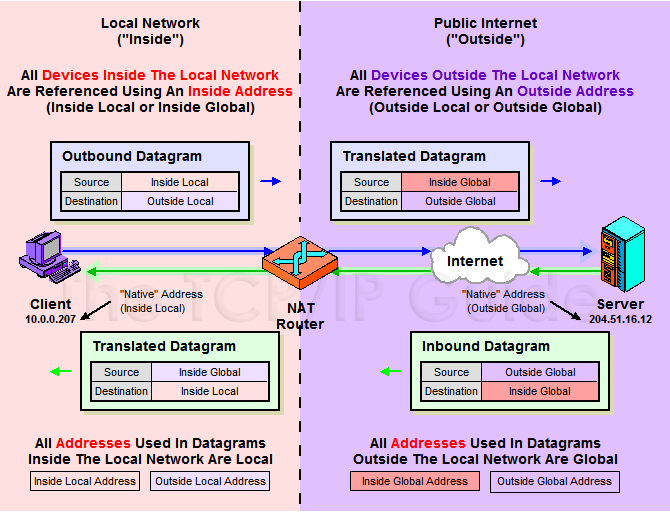
And after all that… it's still confusing. J One of the big problems is that the words “inside” and “local” are somewhat synonymous, as are “outside” and “global”, yet they mean different things in NAT. And the typical paradox in trying to explain networking concepts rears its ugly head here again: I wanted to define these addresses to make describing NAT operation easier, but find myself wanting to use an example of NAT operation to clarify how the addresses are used.
Even after writing this section I find these terms confusing, so I created Figure 111, which shows this same terminology in graphical form and may be of some help. That diagram is also used as a template for the illustrations of each of the different types of NAT in subsequent topics, which use the same color coding for each of the four address types for consistency. As you read the topics that discuss NAT operation, remember to look back here if you want to double-check the meaning of address types. Don't get discouraged if it takes a couple of times to get the addresses straight.
|
|
| |||||||||||||||||||
Home - Table Of Contents - Contact Us
The TCP/IP Guide (http://www.TCPIPGuide.com)
Version 3.0 - Version Date: September 20, 2005
© Copyright 2001-2005 Charles M. Kozierok. All Rights Reserved.
Not responsible for any loss resulting from the use of this site.