 |
|
Please Whitelist This Site?
I know everyone hates ads. But please understand that I am providing premium content for free that takes hundreds of hours of time to research and write. I don't want to go to a pay-only model like some sites, but when more and more people block ads, I end up working for free. And I have a family to support, just like you. :)
If you like The TCP/IP Guide, please consider the download version. It's priced very economically and you can read all of it in a convenient format without ads.
If you want to use this site for free, I'd be grateful if you could add the site to the whitelist for Adblock. To do so, just open the Adblock menu and select "Disable on tcpipguide.com". Or go to the Tools menu and select "Adblock Plus Preferences...". Then click "Add Filter..." at the bottom, and add this string: "@@||tcpipguide.com^$document". Then just click OK.
Thanks for your understanding!
Sincerely, Charles Kozierok
Author and Publisher, The TCP/IP Guide

|
|

|

Custom Search
|

|


IPv6/IPv4 Address Embedding
(Page 2 of 2)
IPv4-Mapped IPv6 Addresses
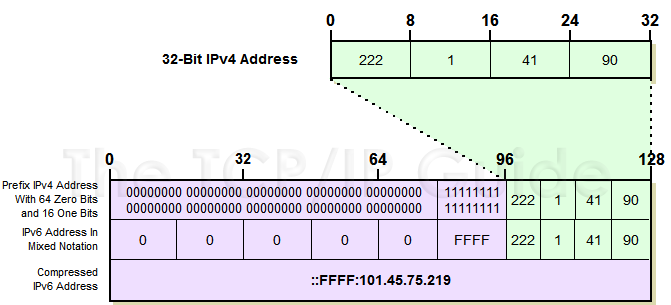
These are regular IPv4 addresses that have been mapped into the IPv6 address space, and are used for devices that are only IPv4-capable. They have a set of 16 ones after the initial string of 80 zeroes, and then the IPv4 address. So, if an IPv4 device has the address 222.1.41.90, such as the one in Figure 100, it would be represented as 0:0:0:0:0:FFFF:222.1.41.90, or ::FFFF:222.1.41.90.
|
|
 Key Concept: IPv4 address embedding is used to create a relationship between an IPv4 address and an IPv6 address to aid in the transition from IPv4 to IPv6. One type, the IPv4-compatible IPv6 address, is used for devices that are compatible with both IPv4 and IPv6; it begins with 96 zero bits. The other, the IPv4-mapped address, is used for mapping IPv4 devices that are not compatible with IPv6 into the IPv6 address space; it begins with 80 zeroes followed by 16 ones.
The difference between these two kinds of addresses is subtle, but important. The first 80 bits are always zero, so when this is seen you know it is an embedded IPv4 address of some sort. IPv4-compatible IPv6 addresses are only used for devices that are actually IPv6-aware; the IPv4-compatible address is in addition to its conventional IPv6 address. In contrast, if the "FFFF" is seen for the 16 bits after the initial 80, this designates a conventional IPv4 devices whose IPv4 address has been mapped into the IPv6 format. It is not an IPv6-capable device.
|
| |||||||||||||||||||
Home - Table Of Contents - Contact Us
The TCP/IP Guide (http://www.TCPIPGuide.com)
Version 3.0 - Version Date: September 20, 2005
© Copyright 2001-2005 Charles M. Kozierok. All Rights Reserved.
Not responsible for any loss resulting from the use of this site.