 |
|
Please Whitelist This Site?
I know everyone hates ads. But please understand that I am providing premium content for free that takes hundreds of hours of time to research and write. I don't want to go to a pay-only model like some sites, but when more and more people block ads, I end up working for free. And I have a family to support, just like you. :)
If you like The TCP/IP Guide, please consider the download version. It's priced very economically and you can read all of it in a convenient format without ads.
If you want to use this site for free, I'd be grateful if you could add the site to the whitelist for Adblock. To do so, just open the Adblock menu and select "Disable on tcpipguide.com". Or go to the Tools menu and select "Adblock Plus Preferences...". Then click "Add Filter..." at the bottom, and add this string: "@@||tcpipguide.com^$document". Then just click OK.
Thanks for your understanding!
Sincerely, Charles Kozierok
Author and Publisher, The TCP/IP Guide

|
|

|

Custom Search
|

|


OSPF Message Formats
(Page 1 of 7)
OSPF uses five different types of messages to communicate both link-state and general information between routers within an autonomous system or area. To help illustrate better how the OSPF messages are used, it's worth taking a quick look at the format used for each of these messages. Well, I guess I am being somewhat liberal in my use of the term “quick” here. J
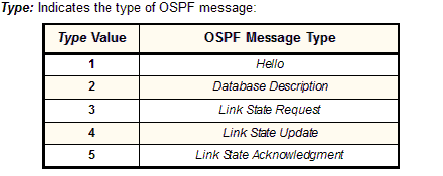
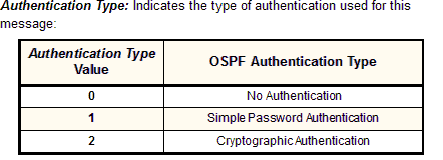
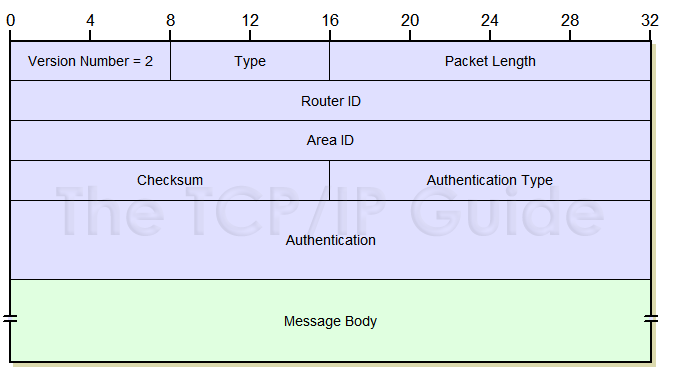
Naturally, each type of OSPF message includes a slightly different set of information—otherwise, they wouldn't be different message types! However, they all share a similar message structure, beginning with a shared 24-byte header. This common header allows certain standard information to be conveyed in a consistent manner, such as the number of the version of OSPF that generated the message. It also allows a device receiving an OSPF message to quickly determine which type of message it has received, so it knows whether or not it needs to bother examining the rest of the message.Table 126 and Figure 184 show the common OSPF header format.
Field Name |
Size (bytes) |
Description |
Version # |
1 |
Version Number: Set to 2 for OSPF version 2. |
Type |
1 |
|
Packet Length |
2 |
Packet Length: The length of the message, in bytes, including the 24 bytes of this header. |
Router ID |
4 |
Router ID: The ID of the router that generated this message (generally its IP address on the interface over which the message was sent). |
Area ID |
4 |
Area ID: An identification of the OSPF area to which this message belongs, when areas are used. |
Checksum |
2 |
Checksum: A 16-bit checksum computed in a manner similar to a standard IP checksum. The entire message is included in the calculation except the Authentication field. |
AuType |
2 |
|
Authentication |
8 |
Authentication: A 64-bit field used for authentication of the message, as needed. |
|
|
| |||||||||||||||||||
Home - Table Of Contents - Contact Us
The TCP/IP Guide (http://www.TCPIPGuide.com)
Version 3.0 - Version Date: September 20, 2005
© Copyright 2001-2005 Charles M. Kozierok. All Rights Reserved.
Not responsible for any loss resulting from the use of this site.