 |
|
Please Whitelist This Site?
I know everyone hates ads. But please understand that I am providing premium content for free that takes hundreds of hours of time to research and write. I don't want to go to a pay-only model like some sites, but when more and more people block ads, I end up working for free. And I have a family to support, just like you. :)
If you like The TCP/IP Guide, please consider the download version. It's priced very economically and you can read all of it in a convenient format without ads.
If you want to use this site for free, I'd be grateful if you could add the site to the whitelist for Adblock. To do so, just open the Adblock menu and select "Disable on tcpipguide.com". Or go to the Tools menu and select "Adblock Plus Preferences...". Then click "Add Filter..." at the bottom, and add this string: "@@||tcpipguide.com^$document". Then just click OK.
Thanks for your understanding!
Sincerely, Charles Kozierok
Author and Publisher, The TCP/IP Guide

|
|
|

Custom Search
|

|


PPP Multilink Protocol (MP/MLP/MLPPP)
(Page 2 of 3)
PPP Multilink Protocol Architecture
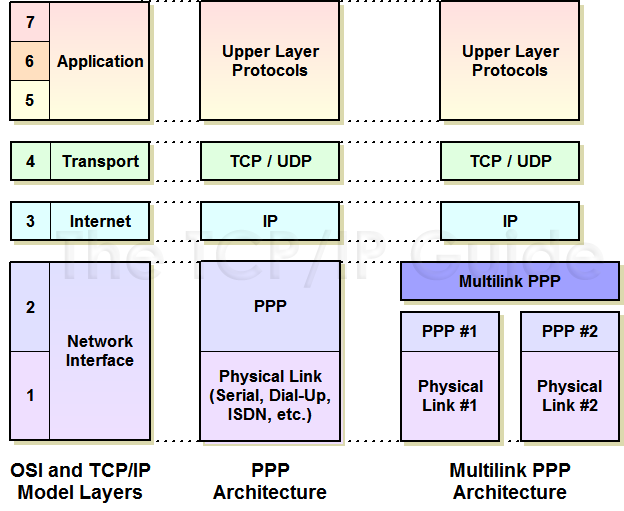
MP is an optional feature of PPP, so it must be designed to integrate seamlessly into regular PPP operation. To accomplish this, MP is implemented as a new architectural “sublayer” within PPP. In essence, an MP sublayer is inserted between the “regular” PPP mechanism and any network layer protocols using PPP, as shown in Figure 31. This allows MP to take all network layer data to be sent over the PPP link and spread it over multiple physical connections, without causing either the normal PPP mechanisms or the network layer protocol interfaces to PPP to “break”.
|
|
 Key Concept: The PPP Multilink Protocol (MP) allows PPP to bundle multiple physical links and use them like a single, high-capacity link. It must be enabled during link configuration. Once operational, it works by fragmenting whole PPP frames and sending the fragments over different physical links.
|
| |||||||||||||||||||
Home - Table Of Contents - Contact Us
The TCP/IP Guide (http://www.TCPIPGuide.com)
Version 3.0 - Version Date: September 20, 2005
© Copyright 2001-2005 Charles M. Kozierok. All Rights Reserved.
Not responsible for any loss resulting from the use of this site.