 |
|
Please Whitelist This Site?
I know everyone hates ads. But please understand that I am providing premium content for free that takes hundreds of hours of time to research and write. I don't want to go to a pay-only model like some sites, but when more and more people block ads, I end up working for free. And I have a family to support, just like you. :)
If you like The TCP/IP Guide, please consider the download version. It's priced very economically and you can read all of it in a convenient format without ads.
If you want to use this site for free, I'd be grateful if you could add the site to the whitelist for Adblock. To do so, just open the Adblock menu and select "Disable on tcpipguide.com". Or go to the Tools menu and select "Adblock Plus Preferences...". Then click "Add Filter..." at the bottom, and add this string: "@@||tcpipguide.com^$document". Then just click OK.
Thanks for your understanding!
Sincerely, Charles Kozierok
Author and Publisher, The TCP/IP Guide

|
|
|

Custom Search
|
 |
The TCP/IP Guide 9 TCP/IP Protocol Suite and Architecture |
|


TCP/IP Protocols
(Page 1 of 4)
Since TCP/IP is a protocol suite, it is most often discussed in terms of the protocols that comprise it. Each protocol “resides” in a particular layer of the TCP/IP architectural model we saw earlier in this section. Every TCP/IP protocol is charged with performing a certain subset of the total functionality required to implement a TCP/IP network or application. They work together to allow TCP/IP as a whole to operate.
First, a quick word on the word “protocol”. You will sometimes hear TCP/IP called just a “protocol” instead of a “protocol suite”. This is a simplification that while technically incorrect, is widely used. I believe it arises in large part due to Microsoft referring to protocol suites as “protocols” in their operating systems. I discuss this issue in more detail in a topic devoted to protocols in the networking fundamentals chapter.
As I mentioned earlier in this section, there are a few TCP/IP protocols that are usually called the “core” of the suite, because they are responsible for its basic operation. Which protocols to include in this category is a matter of some conjecture, but most people would definitely include here the main protocols at the internet and transport layers: the Internet Protocol (IP), Transmission Control Protocol (TCP) and User Datagram Protocol (UDP). These core protocols support many other protocols, to perform a variety of functions at each of the TCP/IP model layers. Still others enable user applications to function.
On the whole, there are many hundreds of TCP/IP protocols and applications, and I could not begin to cover each and every one in this Guide. I do include sections discussing several dozen of the protocols that I consider important for one reason or another. Full coverage of each of these protocols (to varying levels of detail) can be found in the other chapters of this Guide.
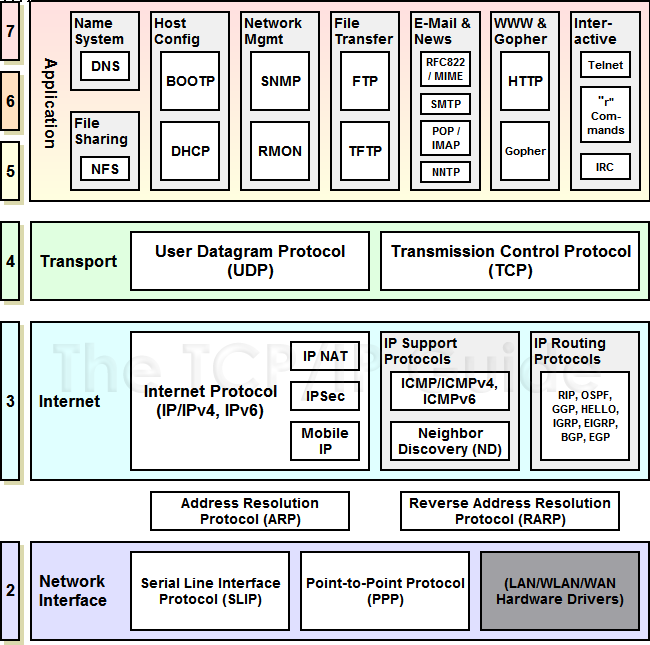
Below I have included a number of tables that provide a summary of each of the TCP/IP protocols discussed in this Guide. Each table covers one of the TCP/IP model layers, in order from lowest to highest, and I have provided links to the sections or topics where each is discussed. The organization of protocols in the TCP/IP suite can also be seen at a glance in Figure 21.
|
|
| |||||||||||||||||||
Home - Table Of Contents - Contact Us
The TCP/IP Guide (http://www.TCPIPGuide.com)
Version 3.0 - Version Date: September 20, 2005
© Copyright 2001-2005 Charles M. Kozierok. All Rights Reserved.
Not responsible for any loss resulting from the use of this site.