 |
|
Please Whitelist This Site?
I know everyone hates ads. But please understand that I am providing premium content for free that takes hundreds of hours of time to research and write. I don't want to go to a pay-only model like some sites, but when more and more people block ads, I end up working for free. And I have a family to support, just like you. :)
If you like The TCP/IP Guide, please consider the download version. It's priced very economically and you can read all of it in a convenient format without ads.
If you want to use this site for free, I'd be grateful if you could add the site to the whitelist for Adblock. To do so, just open the Adblock menu and select "Disable on tcpipguide.com". Or go to the Tools menu and select "Adblock Plus Preferences...". Then click "Add Filter..." at the bottom, and add this string: "@@||tcpipguide.com^$document". Then just click OK.
Thanks for your understanding!
Sincerely, Charles Kozierok
Author and Publisher, The TCP/IP Guide

|
|
|

Custom Search
|

|


IP Routes and Routing Tables
(Page 2 of 3)
Routing Tables in an Example Internetwork
Let’s consider an example (see Figure 93) with routers R1, R2 and R3 connected in a “triangle”, so that each router can send directly to the others, as well as to its own local network. Suppose R1's local network is 11.0.0.0/8, R2's is 12.0.0.0/8 and R3's is 13.0.0.0/8. (I'm just trying to keep this simple. J) R1 knows that any datagram it sees with 11 as the first octet is on its local network. It will also have a routing entry that says that any IP address starting with “12” should go to R2, and any starting with “13” should go to R3.
|
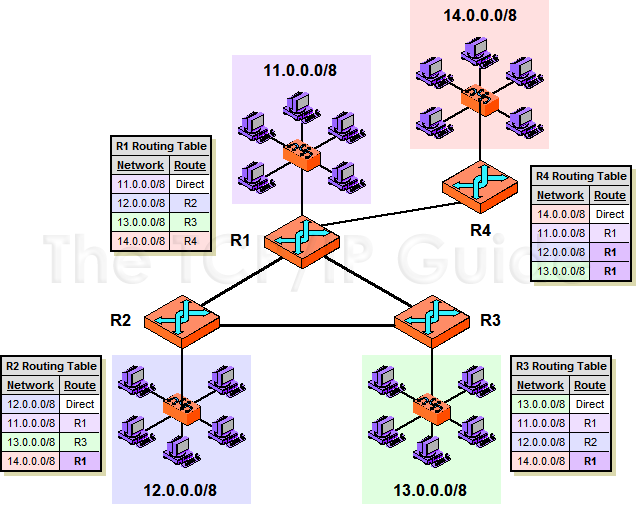
Let's suppose that R1 also connects to another router, R4, which has 14.0.0.0/8 as its local network. R1 will have an entry for this local network. However, R2 and R3 also need to know how to reach 14.0.0.0/8, even though they don't connect to it its router directly. Most likely, they will have an entry that says that any datagrams intended for 14.0.0.0/8 should be sent to R1. R1 will then forward them to R4. Similarly, R4 will send any traffic intended for 12.0.0.0/8 or 13.0.0.0/8 through R1.
|
| |||||||||||||||||||
Home - Table Of Contents - Contact Us
The TCP/IP Guide (http://www.TCPIPGuide.com)
Version 3.0 - Version Date: September 20, 2005
© Copyright 2001-2005 Charles M. Kozierok. All Rights Reserved.
Not responsible for any loss resulting from the use of this site.